After reading countless debates and confusion in Facebook groups, bar requirements directly on venue websites or handouts, and even seeing Bartenders miswording or misunderstanding what is required, I thought it would be beneficial to explain what is ACTUALLY needed, and help guide the proper wording to eliminate confusion between venues and their clients when laying out the requirements of hired Bartenders.
We’ll start here: Venues, if you require a legitimate Bartender, you’re asking for the wrong thing – which is causing confusion between you, your clients, and the Bartender. You don’t need a “Licensed” Bartender. And it’s VERY important (for your own sanity) to understand why you need to re-phrase your requirements. We’ll get to what you actually mean to say shortly.
To preface this, we are based out of Washington State, and although the wording or names of permits and licenses may differ in other states, the overall requirements are most-likely the same if your venue is requiring a “Licensed” Bartender. I have been a Bartender for 16+ years and have owned and operated a mobile bartending service for 10-years as of 2024. As of the date of this post, all information has been confirmed by our local Washington State Liquor and Cannabis Board, but please reach out to your local representive for current rules if applicable.
Let’s start off with the most common used phrases first, followed by what each means:
- MAST Permit
- Licensed Bartender
- Licensed Business
- Liquor License
- Banquet Permit
- BONUS: 1099 vs. w-2 Employees

MAST PERMIT
A MAST Permit comes in TWO types; a Class 12 Permit and a Class 13 Permit. To make it simple, if you are a venue, or your venue requires a legitimate Bartender, no matter which route you go, you need a Bartender with a Class 12 Permit. If you’d like more information on the differences, you can find them HERE.
A Class 12 Permit, in Washington State is a permit that allows an individual to work in a bar (or mobile bar setting) as a Bartender. Neither the Class 12 or Class 13 Permit teach you how to actually bartend – it is merely a piece of paper certifying the holder watched/took a 4-hour video or class to learn about safe serving practices, signs of overintoxication, and why it is important to serve safely.
This is what traditional Bartenders who work at bars usually assume this is all that is required when someone asks if they’re “Licensed.”
*Read about the value of hiring an experienced Bartender HERE no matter the rules in place.
Think of a MAST-Permit like having a driver’s license – not a license to be a commercial taxi service. Nor is it the driver’s insurance, or multiple licenses required to charge people for rides.
LICENSED BARTENDER
In short, this can mean NOTHING and EVERYTHING simultaneously. This isn’t really a “thing.” It’s a misnomer that venues and wedding professionals use (even some Bartenders). It can mean multiple things and the meaning is dependant on who is saying it and what their knowledge means – so by being “everything” it means “nothing.”
Similarly, if you’re sitting down to lunch and your dining partner says “Would you mind sharing some of your fries?” that can mean they want two or three, or it can mean they want half of what’s on your plate.
Why is it important to STOP using this phrase? Just like knowing if your date wants a couple and you’re fine with the small order, or if you both want half so a larger order is required, knowing what is expected is key. A Bartender or Mobile Bar Company holding a Liquor License and a MAST Permitted Bartender are two vastly different things – and it creates confusion on what the couple actually needs. It also creates confusion from the Bartender’s point-of-view, so they unintentionally confirm they are “licensed” when indeed they only hold a MAST Permit, and not a Business License or Liquor License which may be what you actually want.
What you mean to say depends on what YOU, as the venue, require.
LICENSED BUSINESS
This one is pretty straight-forward. Just like any legal and legitimate business in Washington State (and can only assume, other states as well), a business needs a license, to pay taxes, register with the state, hold insurance, etc. This is across the board – whether you are a Landscaper, a Baker, an Accountant – or a Mobile Bartending Service.
To use the example of driving, think of a Licensed Business like having a taxi company, you still need to have a staff with driver’s license, and auto insurance, and the needed requirements to start charging for safe taxi rides, along with general business insurance.
LIQUOR LICENSE
This is the License that a restaurant, bar, or mobile bar needs in order to SELL alcohol by the MAST-permitted staff. That applies whether one is selling alcohol per serving (i.e. charging a customer for a glass of wine) or selling bottles in a retail setting. To summarize, there are different types of licenses for different settings, but we won’t get into that, since the differences don’t apply for our conversation, but again, if you want to learn more, you can do so HERE. In a mobile bar setting an “Off Site Liquor Caterer” endorsement is required for off-site service at a wedding venue or anywhere that is not the registered business address of the liquor license holder.
Sticking with the example of driving, think of a Liquor License like a “Vehicle for Hire” endorsement, you still need to have a staff with driver’s license, and auto insurance, along with general business insurance but now you can legally charge per ride.
BANQUET PERMIT
To pull directly from the WSLCB website, “A Banquet Permit is a permit you apply for that allows the service and consumption of liquor at a private, invitation-only banquet or gathering held in a public place or business. Examples include weddings, company banquets, retirement parties, and club, organization, or church events.” To add, where no alcohol is sold – directly (charge per serving) or indirectly (where one buys a cup or pays a cover charge in exchange for alcohol).
Most Washington State venues require this, and is not the same as a liquor license.
BONUS: 1099 vs. w-2 Employees
I’ll get some flack for this one, but probably 80%*** of mobile bars “hire” 1099 employees, and not w-2 employees (or likely, just paying them “under the table). This is to keep costs down, since the 1099 Bartender is essentially a sub-contractor and “pays” their own taxes, so the mobile bar doesn’t have to pay payroll or any other employer taxes. The glaring problem with that, the business license, the insurance, the permits, all don’t carry over to 1099 employees – so essentially, you’re just getting a MAST-Permitted Bartender, even if they told you and the client they are licensed and insured.
Unfortunately, there are only two ways you can find out if they are properly staffed; first being the hard way, where if something happens to your venue, a guest, or accident off-site caused from someone who consumed alcohol served by the 1099 employee – you and the couple are now held liable. The other way, is by asking for “Proof of Employment” from the mobile bar service ahead of time if the named owner of the company is not the only person on-duty.
***totally made up number with no statistical back-up, but I would be willing to bet a decent sum of money that I’m not far off from that number.
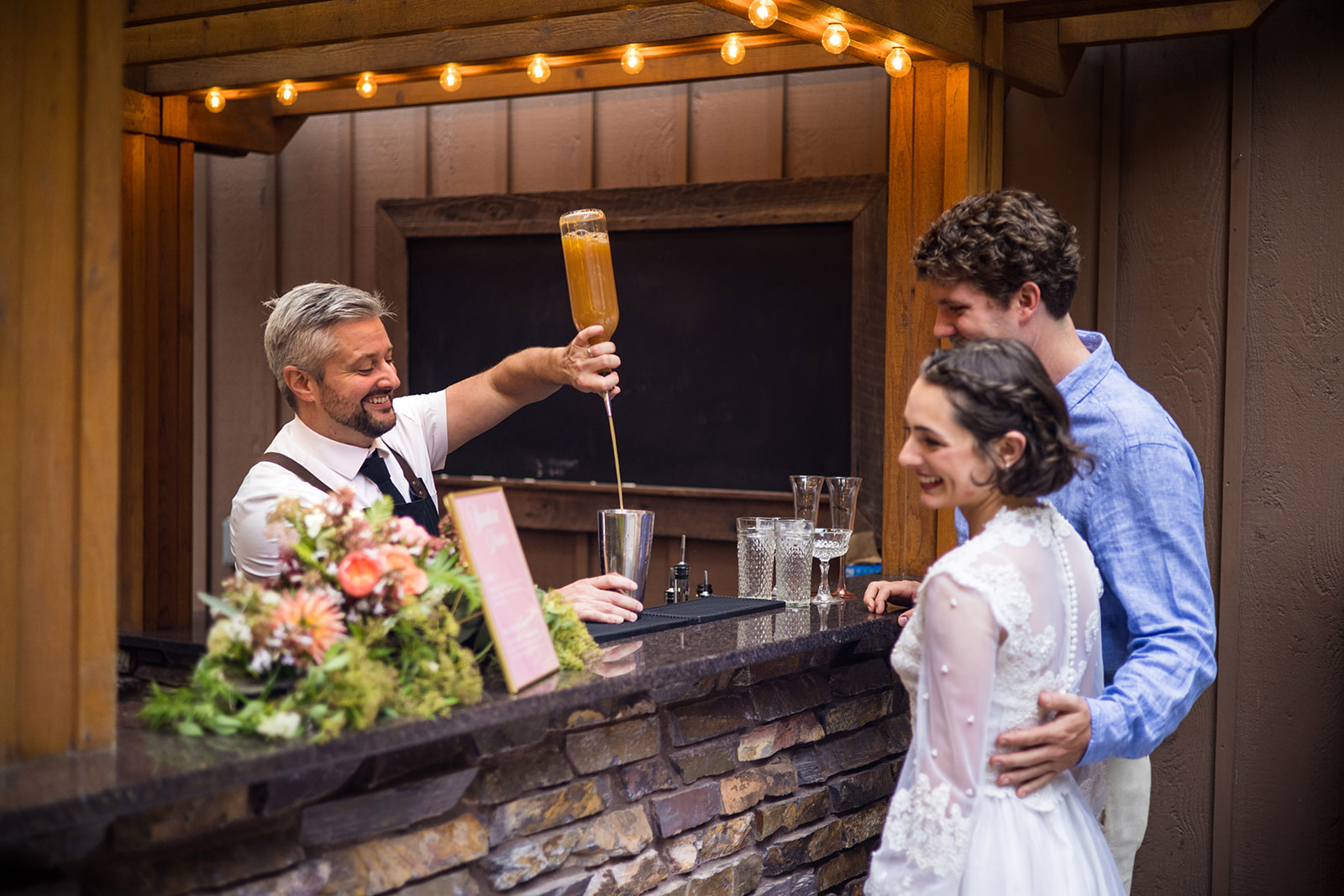 photography: Skywater Photo + Film | venue: Evergreen Gardens – Ferndale, Wa.
So what do you actually need? It all depends on what YOU want to require. We’ll break each option down and include what you should be saying instead to eliminate confusion and ensure you are getting what you actually mean.
NOTE: Each venue can choose any of the following options (or even nothing at all, if they want to assume all liability and re-live the wild west), but these are the most common requirements and the proper way to phrase it, in Washington State, if you want to reduce everyone’s confusion.
- The basic need is a “MAST-Permitted Bartender”
* This means they are a private individual that simply understands how to serve more safely. A Banquet Permit is still required in most cases (whether provided by the Bartender or Client), and there is no general liability or alcohol liability in place unless purchased separately by the hosts to include the Bartender as additionally insured. - What most venues likely require and intend to say, is a “MAST-Permitted Bartender with a Business License and Insurance” is required.
* The Bartender is MAST certified to understand safety, holds a business license and liability insurance to help protect the venue or any damages caused by the w-2 employeed bar staff. - The less-common option is “Mobile Bar Services with a Liquor License.”
* This is only if you know the bar will be selling alcohol, or you’re hosting a public event where alcohol will be sold (or included with a required paid entry).
To underscore why it’s SO important to word it properly, we’ve seen it countless times, where a couple will say their venue requires a “Licensed Bartender” and so they ask their friend from the local pub to bartend, because they have a “License” and the Bartender agrees because they assume (or they themselves don’t understand – again because having a MAST Permit doesn’t cover the laws of actual liquor licensing) they are “licensed” because they are legally allowed to work in a bar. Then fast-forward a few months, the venue asks for their business license, proof of insurance, etc. and the Bartender doesn’t have any of that, and now the couple now has to scramble in order to find a legitimately licensed business with properly permitted Bartenders.
If you want any additional information, or need clarification on anything please don’t hesitate to reach out via comment below, or via email, and we will answer any questions you may have as a venue, wedding professional, hosts or couple, or even mobile bar services – or point you to the right person/agency to help you with your needs.
Leave a Reply